
If you are suddenly seeing ants everywhere in your New Braunfels home—trailing across kitchen counters, circling the bathroom sink, forming lines along the baseboards, clustered around a pet bowl on the floor—the situation feels overwhelming, and the question is natural: why now, and why so many? The answer is that a colony near your home has sent out foragers in response to a specific trigger, and your house is where they found what they were looking for. In Central Texas, those triggers are present for most of the year, which is why ant problems in New Braunfels are so persistent and so difficult to resolve without professional help.
The Direct Answer
Ants are in your New Braunfels home because a colony living in the soil, under your slab, in landscaping, or under hardscaping near your foundation has identified your home as a source of food, water, or shelter. Once a scout ant finds a resource, it lays a pheromone trail—a chemical highway—that recruits hundreds of workers to follow the exact same path. That trail is why ants appear suddenly, move in such organized lines, and keep coming back even after you wipe them away.
What Triggers the Surge
Ant activity inside New Braunfels homes spikes for specific, predictable reasons tied to the Central Texas environment. Understanding which trigger is driving the activity helps explain why it started and what it will take to stop it.
- Heat: This is the most common trigger during the long Central Texas summer. When ground surface temperatures climb into the triple digits—which happens routinely from June through September—the upper layers of soil where ant colonies forage become inhospitable. Colonies send workers into cooler, moister environments, and your air-conditioned home with its plumbing, condensation, and food sources is the best option they have. Kitchen sinks, bathroom faucets, dishwashers, pet bowls, and even condensation on cold water pipes and A/C lines all become targets.
- Rain events: Heavy rainfall—common in New Braunfels in spring and during summer thunderstorms—temporarily floods the shallow tunnel networks where ants forage and raise brood. The colony responds by evacuating to higher, drier ground. When the nest is next to your foundation (and in New Braunfels, it almost always is), the most convenient high ground is inside your home. This is why homeowners often see a dramatic spike in ant activity within 24 to 48 hours after a significant rain.
- Seasonal colony expansion: As soil temperatures warm in March and April, ant colonies that held relatively stable through winter enter their growth phase. New workers hatch, more foragers are deployed, and the territory the colony covers expands rapidly. This is when many homeowners first notice indoor ant activity for the year—not because the ants just arrived, but because the colony that has been living next to the foundation all winter just got a lot bigger and a lot more active.
- Irrigation cycles: Watering your lawn or landscape beds creates the same displacement effect as rain—water saturates the soil near the foundation, floods shallow nest tunnels, and drives ants toward and into the home. Homes with irrigation heads pointed toward the foundation or with planting beds that drain toward the house are particularly vulnerable.
- Drought stress: The opposite of flooding—extended dry periods deplete outdoor moisture sources and drive ants inside specifically for water. In the Central Texas summer, the combination of extreme heat and dry conditions between rain events makes your home’s plumbing fixtures irresistible. This is why ant trails in summer so often lead directly to the kitchen sink, the bathroom faucet, or the dishwasher—they are not after your food. They are after your water.
Which Ants Are You Seeing?
The species matters because different ants require different treatment approaches.
- Small, uniform, light brown ants trailing in dense lines—most likely Argentine ants or odorous house ants (the classic “sugar ants”). These are the most common indoor-trailing species in New Braunfels. They form large colonies near foundations and respond to heat and moisture triggers by sending large numbers of foragers indoors.
- Very small, fast-moving ants that seem to wander erratically rather than trail in a straight line—likely tawny crazy ants. These ants form massive supercolonies and are attracted to electrical equipment. If you find them congregating inside outlets, switches, A/C units, or breaker boxes, crazy ants are the probable species.
- Larger ants, dark brown or black, sometimes with wings—possibly carpenter ants. If you are seeing large ants indoors along with small piles of sawdust-like debris near wood, carpenter ants may be excavating galleries inside structural wood.
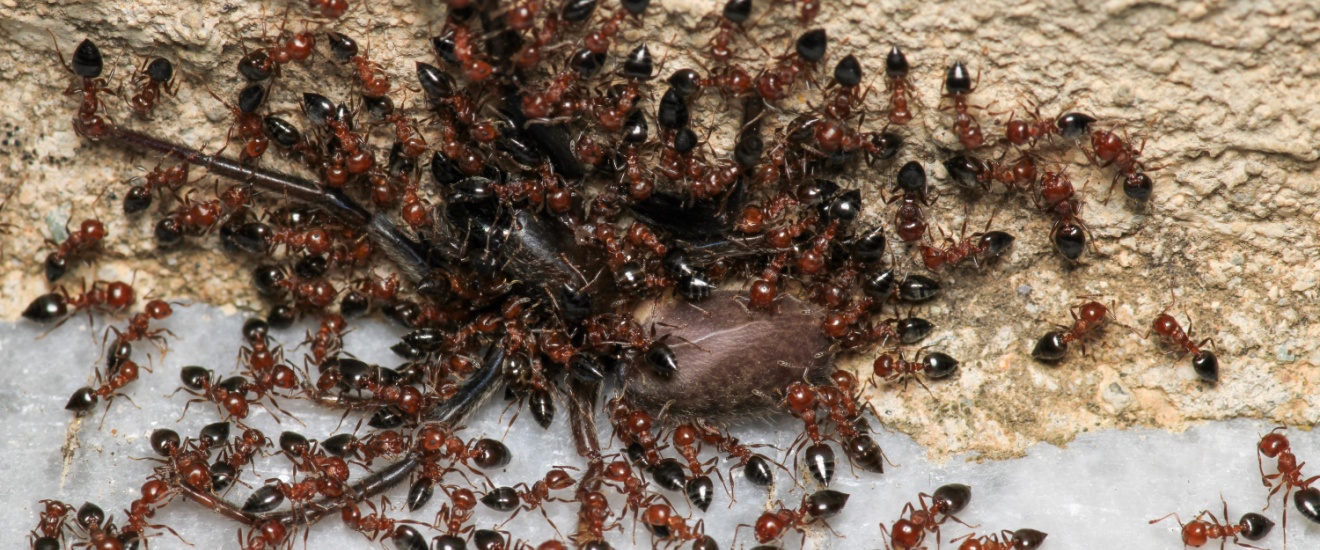
- Reddish-brown ants with aggressive behavior and visible mounds in the yard—fire ants. While fire ants are primarily an outdoor pest, they can and do enter homes through foundation cracks, expansion joints, and gaps around utility penetrations.
What You Can Do Right Now
Immediate steps to reduce activity:
- Wipe down the trail with soapy water or a vinegar-and-water solution to break the pheromone signal
- Identify and remove the food or moisture source the ants are targeting
- Seal the specific entry point if you can find it—caulk, weatherstripping, or expanding foam
- Clean under appliances, behind trash cans, and in pantry areas where crumbs and residue accumulate
- Empty and dry pet water bowls overnight if ants are targeting them
One critical thing to avoid: do not spray the trail with a repellent product from the hardware store. Repellent sprays scatter the colony without killing it. With Argentine ants, they trigger colony budding—the colony splits into multiple new colonies. With fire ants, they cause mound relocation. You end up with a bigger, more dispersed problem than you started with.
When to Call a Professional
If ants return after you clean the trail and remove the attractant—and in New Braunfels, they almost always do—the colony is established close enough to your home that foragers will continue finding new routes inside. At that point, professional treatment that targets the colony with non-repellent products is the most effective path to resolution.
Deep Six Pest Control treats all ant species common to New Braunfels—sugar ants, fire ants, carpenter ants, crazy ants, and more. The company’s Defender and Fortress packages include spot treatment of fire ant mounds near the home, and the Fortress plan extends treatment to the full yard. All services are safe for families and pets, and chemical-free options are available.
If ants have taken over your home and DIY efforts are not cutting it, contact Deep Six Pest Control for a free estimate and get colony-level treatment that stops the problem at its source.